You found a house you love. The seller accepted your offer. Now your agent tells you to get a home inspection — and you're wondering if you really need to spend that money.
Short answer: yes. Every single time.
Here's why.
What a Home Inspection Actually Is
A home inspection is a visual examination of the property by a licensed inspector — typically lasting two to four hours. They walk every inch of that house and give you a written report on what they found: the roof, the foundation, the HVAC systems, plumbing, electrical, windows, doors, insulation, and more.
You're paying someone to tell you exactly what you're buying before you own it.
Why It Matters More in the Mountains
Western North Carolina is beautiful, but our terrain and climate create conditions that buyers from flatter, drier parts of the country don't always think about.
Moisture and drainage. Mountain properties can have serious drainage issues — water intrusion in basements, crawl spaces that stay wet, and grading that funnels water toward the foundation instead of away from it. These problems are expensive. An inspector catches them before they're yours.
Steep-site foundations. Lots of homes in WNC are built on hillsides. That means retaining walls, unusual foundation configurations, and sometimes movement over time. A good inspector knows what to look for.
Aging systems. Many homes in Buncombe, Madison, and the surrounding counties were built decades ago. That means older HVAC systems, older electrical panels (some older panels can raise insurability questions), and plumbing that may be near the end of its useful life.
Unpermitted work. It happens. Someone added a room, finished a basement, or put up an outbuilding without pulling a permit. An inspector can flag work that looks non-standard — which gives you the information you need to ask questions and make decisions.
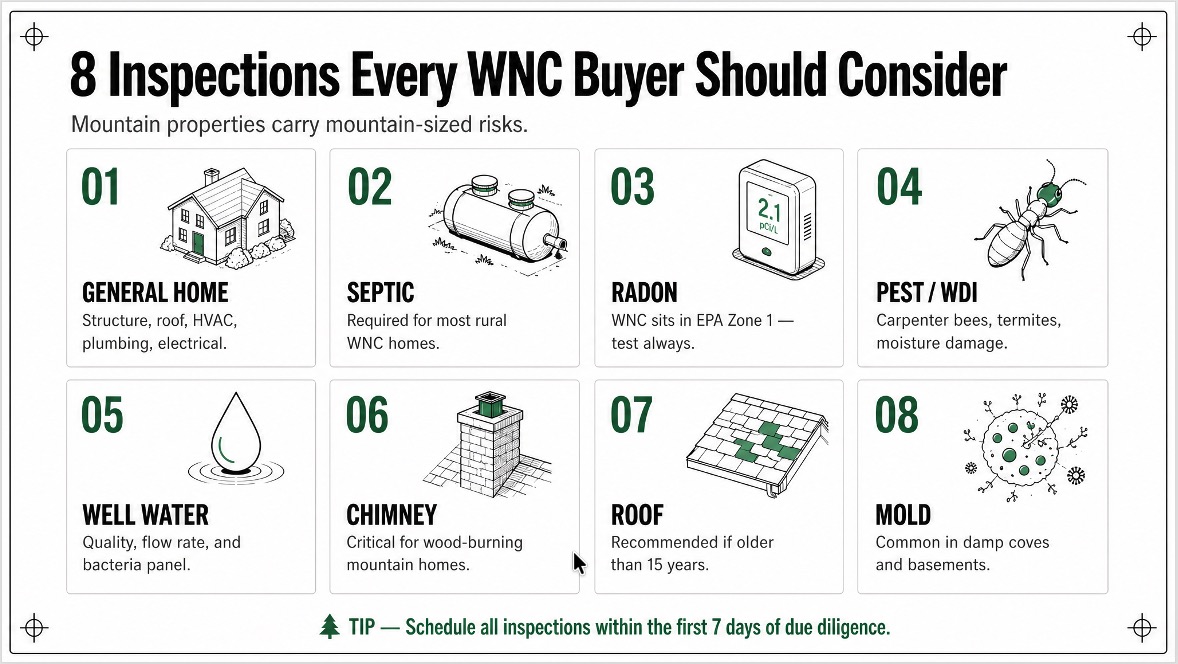
Specialty Inspections to Consider
A general home inspection covers a lot of ground, but it doesn't cover everything. Depending on the property, you may want to add one or more of these speciality inspections. Talk with your inspector and your agent about which ones make sense for your situation.
Well inspection. If the home is on a private well, a well inspection looks at the well system itself — the pump, pressure tank, casing, and flow rate. This is separate from testing the water. Outside of the Asheville, Weaverville, Woodfin and other town and city Limits, you will see many homes on wells.
Water testing. Even a well that runs well mechanically can produce water you don't want to drink. Water tests check for bacteria (like coliform and E. coli), nitrates, heavy metals, and other contaminants.
In some parts of WNC, naturally occurring substances in the soil and bedrock can show up in well water, so testing matters.
Septic inspection. If the property uses a septic system, get it inspected. The inspector evaluates the tank, drainfield, and overall system condition. Septic repairs and replacements can be very expensive, depending on the system, soil conditions, and site access — so knowing the condition up front is important.
I have helped many people who didn't know anything about septic systems. Basically a septic system is a private underground wastewater system. underground wastewater treatment system used on properties that aren't connected to a municipal sewer line. When water goes down your drains or you flush the toilet, it flows into a buried tank where solids settle to the bottom and liquids flow out to a drainfield — a series of perforated pipes spread through the soil that slowly filters and disperses the wastewater naturally. They're common in rural and semi-rural areas like much of Marshall, Mars Hill, Weaverville, Burnsville, Candler, Leicester, and other areas that are far away from the sewer lines. They require regular maintenance and pumping to function properly.
Sewer scope. For homes on public sewer, a sewer scope sends a camera through the line from the house to the street. This catches root intrusion, cracks, bellies, and collapses in the lateral line — issues that aren't visible during a standard inspection and can be costly to repair.
Termite inspection (WDO/WDI). Sometimes called a wood-destroying organism or wood-destroying insect inspection. It checks for termites, carpenter ants, powder post beetles, and wood-destroying fungi. In WNC's humid climate, this is worth taking seriously. Some loan types require this inspection.
Radon testing. Radon is a naturally occurring radioactive gas that can seep into homes from the ground. Parts of Western North Carolina sit in areas where elevated radon levels have been documented, so testing is a good idea regardless of the home's age. If levels come back high, mitigation systems are available.
Chimney inspection. If the home has a fireplace, woodstove, or chimney of any kind, get it inspected by a certified chimney sweep. They check for creosote buildup, cracked flue liners, damaged crowns, and structural issues. Chimney problems can lead to house fires or carbon monoxide issues if they aren't caught.
There are many others too — mold testing, lead paint testing on older homes, asbestos, pool inspections, structural engineer evaluations if something seems off. Your inspector should tell you if they see something that needs a specialist's eyes.
What Happens If You Skip It?
You close on the house and then discover problems the seller didn't disclose — not necessarily because they were hiding anything, but because they didn't know either. They've been living there for years. People get used to things.
An inspection helps protect you from buying someone else's deferred maintenance.
The Due Diligence Period in North Carolina
North Carolina buyers typically have a Due Diligence Period built into the contract — that's your window to investigate the property. Inspections happen during this time.
If the inspection turns up serious issues, you have options:
- Ask the seller to repair specific items before closing
- Negotiate a price reduction or seller concession to account for the cost of repairs
- Terminate the contract within the Due Diligence Period and generally get your Earnest Money Back.
One thing to understand: in North Carolina, the Due Diligence Fee paid to the seller at contract is generally non-refundable, even if you terminate during the Due Diligence Period.
Your Earnest money is a separate deposit and is typically refundable if you terminate within that window. The specifics depend on how your contract is written, so talk to your agent before you sign anything.
The inspection isn't just information. It's leverage. But only if you actually get one.
What to Look for in an Inspector
Not all inspectors are the same. Here's what matters:
- Licensed in North Carolina — home inspectors in NC are licensed by the NC Home Inspector Licensure Board
- Experience with WNC properties specifically — mountain homes have unique characteristics
- Thorough written reports with photos — you need documentation, not just a verbal rundown
- Willingness to let you attend — a good inspector will walk you through findings in person
- Reviews – Take a look at other clients experience
For specialty inspections (septic, well, chimney, termite, radon, sewer scope), you'll typically need different specialists, many of whom the home inspector has relationships with. Ask your agent for recommendations.
Most agents have a short list of inspectors and specialists they trust.
The Bottom Line
Inspection costs vary based on the size of the home, the location, and which specialty inspections you add on. A general home inspection is typically one of the largest costs, with specialty inspections (well, septic, radon, chimney, sewer scope, termite) adding to that depending on what the property needs.
That's a small amount of money compared to the peace of mind — and possible negotiating position — that comes with knowing exactly what you're getting into before you sign at the closing table.
If you have questions about the buying process in Buncombe, Madison, or the surrounding WNC counties, I'm happy to talk about helping you find your next home.
David Stephens | Broker, REALTOR® NextHome Mountain Horizons | BrokerDavid.com 149 Weaver Blvd #117, Weaverville, NC 28787
Each office is independently owned and operated.
Disclaimer
I am a licensed North Carolina real estate broker, not a licensed home inspector. The information in this article is general guidance based on my experience working with buyers in Western North Carolina and is not a substitute for the professional opinion of a licensed home inspector or other qualified specialist. Inspection costs, scope of work, and findings vary by property and by inspector. Speak with your chosen licensed professionals when making decisions about a real estate purchase.